
Love, Loss, and the Practice of Presence
Change sits at the heart of being human. It’s not an interruption to life, but life itself. We cross thresholds constantly, sometimes willingly, sometimes dragged by circumstance, often without clear instructions for how to do it well.

Photo by Ryan Vitter
It’s no use asking why change comes about. It’s inevitable. Instead, we must ask ourselves:
How will I meet change?
How do I stay open instead of resisting?
How do I stay centered when everything around me is in flux?
When Memory Changes, Love Does Not
Last week, I had the honour of designing and officiating a Celebration of Life for a man who lived with early-onset Alzheimer’s for almost fifteen years. Fifteen years is a long goodbye. A slow unravelling. A steady accumulation of grief that doesn’t wait politely until death.
And yet, during that ceremony, something remarkable happened.
As stories were shared, as laughter bubbled up alongside tears, it felt as though his healthy self was present again in the room. His warmth. His humour. His devotion to family and community. His unmistakable spark.
His daughter later told me and wrote in a review of the ceremony that it had been an unexpectedly healing experience. Her words stayed with me.
They speak to something I see again and again. When we slow down, when we practice presence, when we make room for the full range of the human experience, something essential returns.
Presence as a Way Through
I began learning this lesson years ago, during a formative chapter of my life.
I had recently moved to North Carolina with my husband, and our then-toddler and two-month-old baby. I was tender, tired, searching. It was during that time that I met my dear friend and mentor, Juanita Johnson.
I took courses from Juanita on life transitions, ethical wills, and relationships. But more than anything, she taught presence. How to meet uncertainty with curiosity instead of fear. How to remain connected to what is true.
Under her guidance, I helped establish a small gathering of young mothers. We met regularly, without our children, to talk honestly about identity, longing, purpose, and change. It was simple, and it was profound.
Those experiences shaped me deeply. They continue to inform how I live, how I listen, and how I hold space for others.
[Quick aside: If you’d like to practice this skill or are also drawn to these kinds of experiences, join me in an upcoming Heart of Being Human community conversation. More info on these free gatherings here.]
Love in the Time of Forgetting
Years later, Juanita would be called into a much more demanding threshold as she companioned her beloved husband, Earl, through his diagnosis, illness, and eventual death from Lewy body dementia. She has written about this journey in her luminous new book, Love in the Time of Forgetting: A Memoir of Love and Life After Loss with Lewy Body Dementia (available through her publisher, at Barnes and Noble, on Amazon, or wherever you find books).
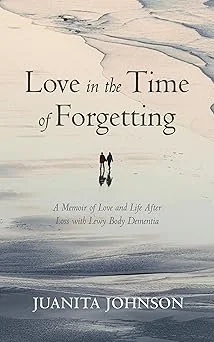
What emerges in Juanita’s book is not a denial of grief, but an expansion of it. Here’s how she described it:
“At its heart, this book is about marriage, long love, and what it means to stay emotionally present as life asks more of us than we ever expected. It explores resilience, vulnerability, devotion, and the quiet courage required when the familiar begins to change. Through reflections and lived moments, I write about how love can deepen rather than disappear when circumstances grow difficult, and how meaning can still be found in uncertainty and loss.”
Reading her words alongside my recent experience of the memorial ceremony felt quietly instructive. Different families. Different forms of dementia.
And yet the same invitation: To stay. To bear witness. To remain connected.
Slowing Down Enough to Remember
The daughter who wrote that ceremony review named something essential. She spoke about being seen. About being relieved of stress. About the power of slowing down enough to truly remember who her father had been.
This is not just about ceremonies. It’s about how we meet one another in times of profound change.
When we rush, we miss the subtle truths. When we avoid discomfort, we lose access to depth. When we try to fix or tidy grief, we rob it of its wisdom.
Presence asks something else of us. It asks us to listen carefully and allow complexity. To honour both what has been lost and what endures.
Carrying This Forward
The practices Juanita taught me years ago are the same ones I now try to embody in my work and in my life. Staying open. Creating space. Trusting that connection is possible even in the midst of loss.
Whether we are navigating illness, caregiving, death, or the quieter transitions that shape us, the invitation is the same.
We can resist. Or we can soften.
We can rush through thresholds. Or we can pause and cross them with intention.
When we choose the latter, something true and vital emerges.
If this reflection spoke to you, consider joining the next free, online Heart of Being Human gathering.
Twice a month, we come together for real, nourishing conversations about the stuff of life: what it means to live with intention, to care deeply, and to keep our hearts open to change and connection.

Photo credit: Emma Love Photography
Author: Karla Combres
As a Legacy Guide & Celebrant, I help individuals, couples, families and organizations make the big and small moments in life count, and shape their legacy along the way. I offer:
Drawing on my vast experience as a Life-Cycle Celebrant and in working with people at the end of life, I am uniquely qualified to help people move through transitions meaningfully and to think about how they want to leave this world so they can live better now.
I’m based in Saskatchewan, Canada and serve clients worldwide. Read more about me here.